A project can use the best technology in the world and still leave people cold.
I have seen technically ambitious works transform the way people experience a place, and others disappear from memory almost as soon as the lights are turned off. The difference is rarely the equipment. It is whether the work has found a reason to exist there.
Technology naturally attracts attention. We talk about projectors, sensors, robotics, data and software because they make previously impossible things possible. Artists continue to push these tools in extraordinary directions, but technical achievement alone does not make an experience meaningful.
The more important question is often much simpler: why does this work belong here?
The same tools can produce completely different experiences
I have seen similar technologies used across historic buildings, hospitals, public squares, festivals and transport networks. On paper, the projects may appear to have a great deal in common. They might use the same type of projection, responsive system or lighting equipment.
The experience can be entirely different.
Some works feel inseparable from their surroundings. Others feel as though they have been placed on top of a location without ever really engaging with it. They may be impressive for a few minutes, but once the initial effect has passed, there is little reason to keep thinking about them.
Place is more than a physical setting. It carries history, memory, identity and habits that may not be immediately visible. People already have a relationship with it. They know who gathers there, how it changes throughout the day and what it means within their lives.
An artist may notice something that everyone else has stopped seeing. A detail in the architecture. A story connected to the site. The way people move through it. A tension between what a place was and what it is becoming.
When a work responds to these things, it can reveal something that was already present but overlooked. When it does not, even the most sophisticated project can feel generic.
Artists need to be part of the first conversation
This is why artists should enter the process early.
Too often, the concept, format and technology have already been decided before an artist is invited to participate. By that stage, there may be very little left for them to shape. They are being asked to interpret someone else’s plan rather than bring their own way of seeing to the project.
Artists can ask questions that commissioners, producers and technical teams may not think to ask.
Why here?
Why now?
Who already uses this space?
What is missing?
What might this place allow us to experience differently?
These questions can change the direction of a project. That can be uncomfortable, particularly when plans, budgets and expectations are already taking shape. But it is often where the work begins to find its purpose.
Listening matters just as much. Listening to the artist, to the people who understand the site and to the stories already connected to it. This does not mean that every artwork must explain a place or attempt to represent everyone who encounters it. It means recognising that the work is entering a living environment, not an empty stage.
Art can change an ordinary place
Some of the most meaningful effects of public art are surprisingly simple.
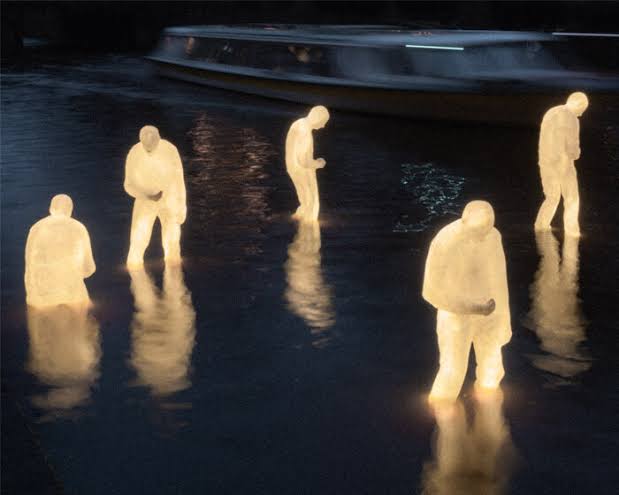
A building people pass every day becomes visible again. A public square becomes somewhere people choose to stay. A hospital corridor offers an unexpected moment of calm. Strangers pause beside one another and begin talking about what they are seeing.
I have watched people return to places they previously ignored because an artwork gave them a new reason to be there. I have seen children understand a work immediately while the adults around them were still trying to work it out. I have seen familiar spaces become unfamiliar for a moment, allowing people to look at them with fresh attention.
These responses can be difficult to measure, but they matter. They show that the artwork has changed the relationship between people and their surroundings, even if only briefly.
Temporary works can be especially powerful in this way. The physical artwork may disappear after a few nights or weeks, but the memory of the place can remain altered. It becomes connected to an experience, a conversation or a moment shared with someone else.
Technology can help an artist create that encounter. It can alter scale, respond to movement, transform architecture or create environments that could not exist otherwise. But technology cannot decide why the work matters.
The projects I remember most clearly are not necessarily the largest, most expensive or most technically complex. They are the ones that could not simply be moved somewhere else without losing something essential.
They belonged to their place, and for a while, they helped us belong there too.